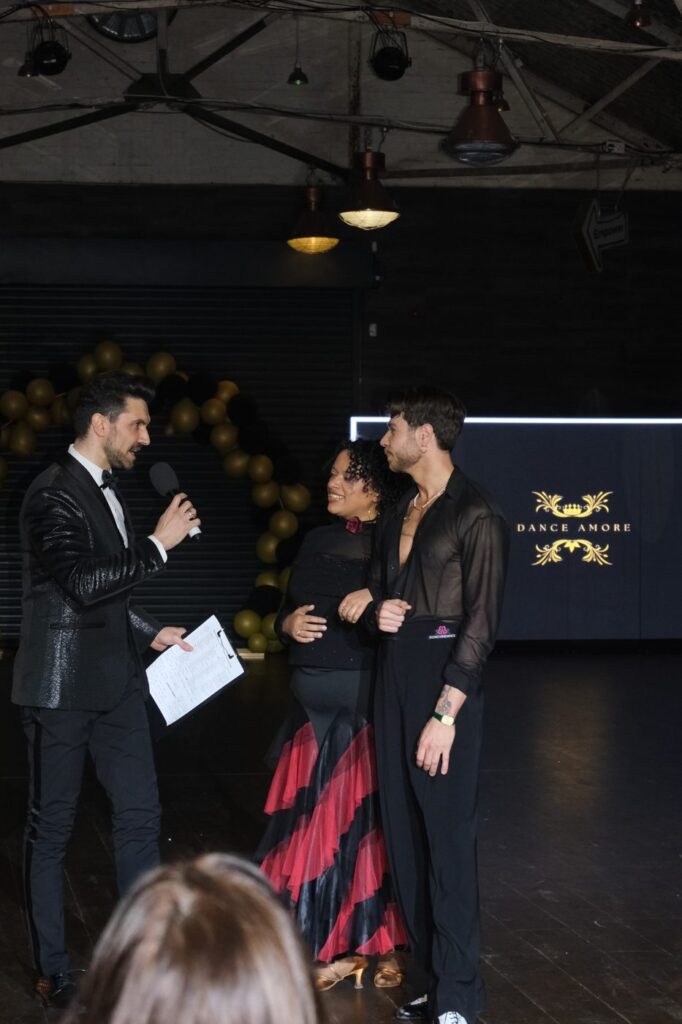
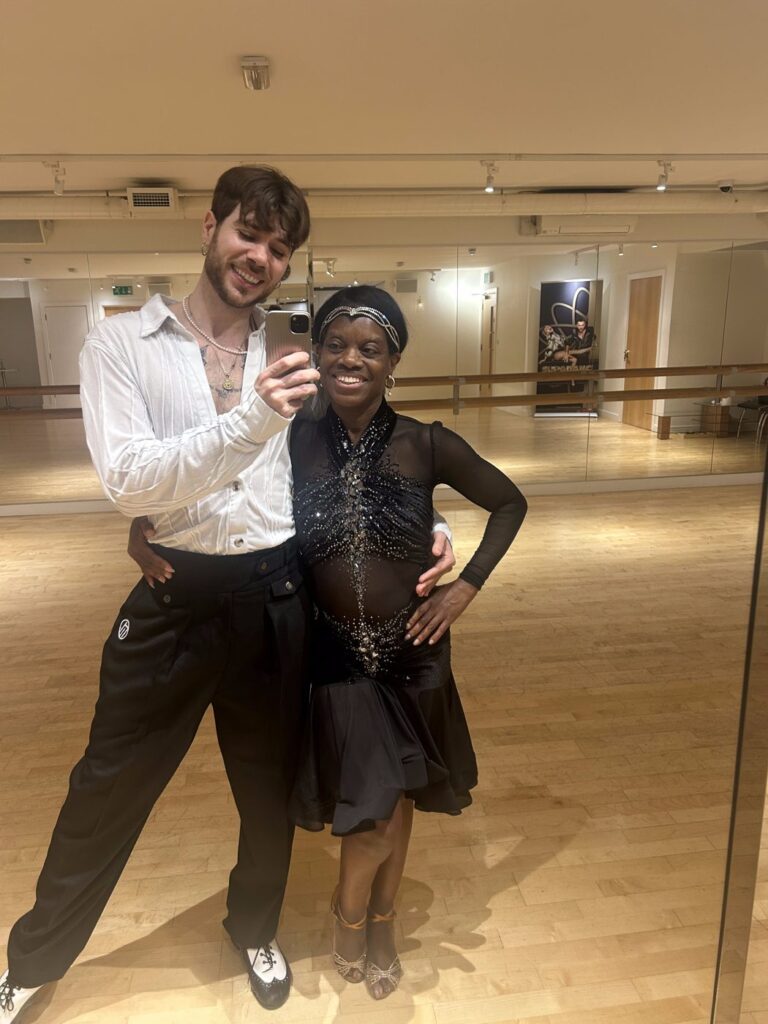
The studio sits on Chilworth Mews, a quiet cobbled lane three minutes on foot from Paddington station. You push the door open, hang your coat and change your shoes. The floor is sprung, so it gives very slightly underfoot and your knees will thank you an hour later. There’s a mirror along one wall and music already playing, because the music is nearly always on. Someone says hello, asks how your week has been, and the lesson starts. That is the shape of private dance lessons in London at Dance Amore Studio, and if you’ve never had one to one dance lessons before, this is the picture nobody gives you.
The first ten minutes are the gentlest part. Martynas, who teaches most of the individual dance lessons here, will walk you through some easy movement to get your weight settled and your shoulders down. Nothing complicated. You’ll shift from one foot to the other in time with the music until it stops feeling like a task. He’ll ask what you’ve come for, and he means it as a real question, because the answer changes what happens next. A wedding in four months is a different lesson from wanting to enjoy a cruise ship dance floor, which is different again from having watched Strictly for fifteen years and finally decided it’s your turn.
What actually happens in the room
There are two of you. That’s the whole thing, and it changes how the hour runs.
Nobody is waiting for you, and you’re not waiting for anybody. If the basic step of a waltz clicks in six minutes, you move on in six minutes. If it takes forty, you take forty, and nobody sighs. The music is chosen for you, at a tempo you can actually hear the beat in. When you get something wrong, you’re told immediately and shown the correction while your body still remembers what it just did.
That last part matters more than people expect. In a room of twenty, a teacher sees your mistake perhaps twice in an hour. One to one, every repetition is watched, so you won’t spend six weeks quietly grooving a habit that then takes three months to unpick.
There’s also the plain fact that nobody else is in the room. For a lot of adults this is the deciding factor, and there’s nothing embarrassing about it. Learning to dance means being visibly not good at something for a while, in front of a mirror, in a body you may not entirely trust yet. Doing that with one person whose whole job is to be encouraging and useful is a very different experience from doing it in a line of strangers.
Why one to one dance lessons work so well for adults
Adults learn better when the material is chosen for them. A group class follows a fixed syllabus because it has to. Week three is week three whether or not week two landed for you, and the content was decided before anyone knew you existed.
A private lesson has no syllabus except yours. If you love the cha cha and have no interest in the foxtrot, you dance cha cha. If your husband proposed to Sinatra and you want to move properly to that one song, that becomes the lesson. Look at the full range of styles taught at the studio and simply pick, then change your mind in a month when something else catches you.
Adults also come with real bodies. Old knee injuries, a stiff lower back, a shoulder that doesn’t go all the way up any more. In a group you work around those quietly and hope. One to one, they’re part of the conversation in the first lesson.
The pro-am model, explained plainly
Pro-am simply means you dance with a professional. You are the amateur, your teacher is the pro, and that partnership is the lesson. It’s how the studio’s one to one tuition is built, and it has two consequences worth understanding.
The first is practical. You never need to bring a partner. Around forty to fifty people take regular one to one lessons here, and most of them arrived alone. If you’re single, or your partner would rather do almost anything else on a Tuesday evening, that’s no barrier.
The second is more interesting. Ballroom and Latin are partner dances, so the feeling of them lives in the connection between two people. Dance with another beginner and you’ll spend months negotiating: neither of you leads clearly, neither follows confidently, and the dance stays a set of steps you’re both counting. Dance with a professional who leads or follows properly and you feel the real thing on day one. You’ll be led into a turn before you know how to do the turn, and your body will understand what it’s aiming at long before your head catches up.
Fitting lessons around a real week
The studio is open Monday to Saturday, from ten in the morning until ten at night, and scheduling is built around the student rather than a timetable. Early morning before work, the middle of a quiet Wednesday, half past eight on a Thursday evening. If you travel for work or your diary changes shape every month, you’re not forcing a fixed weekly class slot to survive contact with your actual life.
Paddington station is a three minute walk away, so the studio is easy to reach from most of London. There’s no parking nearby, so public transport or a taxi to the door is the sensible plan.
What progress actually looks like
Honestly? The first two or three lessons feel clumsy, and then something settles. By around six weeks most students can get through a simple sequence to music without counting out loud. By three months, if you’ve been coming consistently, you tend to have one or two dances that feel like yours, plus the beginnings of decent posture, which is often the change other people notice first.
The single biggest factor is not talent. It’s turning up. Someone with no natural rhythm who comes every week will overtake a gifted student who appears once a month. Ten minutes of practice at home, standing in your kitchen while the kettle boils, does more than you’d think.
Where private lessons lead, if you want them to
Some people stay where they start, dancing for the pleasure of an hour a week, and that’s a perfectly good ending. Others go further. Social dancing is the most common next step, arriving at a party or a holiday dance floor and actually wanting to be on it. Wedding first dance lessons are their own particular project, with a deadline and a song and a room full of people watching for ninety seconds.
Then there’s the pro-am competitive route, dancing in showcases and competitions with your professional partner. That’s a bigger commitment, and it isn’t for everyone, but students here do it. Founder and director Simone Arena is a former Italian Ballroom and Latin Champion who won Dancing with the Stars Belgium series three, reached the final of Dancing with the Stars Ireland in 2024 and spent over ten years with the Burn the Floor Broadway production. The competitive world is familiar territory here if you want a door into it.
Private lessons and group classes together
Group classes are not the poor relation, and plenty of students do both. Privates are where technique gets built and fixed. Groups are where you practise it, meet other dancers and get used to moving near other people. One feeds the other, so if you like the idea of company as well as coaching, doing both is a sound way to work.
Questions people ask before their first lesson
Do I need a partner?
No. You dance with your instructor, so you’ll never be short of a partner or paired with someone you don’t know. Couples are welcome too, and many book lessons together, but coming alone is the norm rather than the exception.
How often should I have lessons?
Once a week suits most people and produces steady, visible progress. Twice a week moves things along noticeably faster and is common when there’s a wedding or an event coming. Once a fortnight works, though you’ll spend more of each lesson remembering. Consistency beats intensity.
What should I wear?
Comfortable clothes you can move in, and shoes with a smooth sole that let you turn rather than grip. Trainers are the one thing to avoid. Proper dance shoes are lovely once you’re committed, but there’s no need to buy any before you start.
What if I have absolutely no rhythm?
The most common worry and the least founded. Rhythm is a trained skill, not a gift you were born with or missed out on. Being led by a professional, to music chosen for you, at a tempo you can hear, does most of the work. More answers sit on the studio FAQ page.
Come and try one
The best way to know whether this suits you is to stand in the room and dance for an hour. Book an intro lesson and consultation, meet your instructor and talk through what you want.
Message the studio on WhatsApp on 07480 387419 (text only), call 07737 893113, or email danceamorestudio@gmail.com. Text is the surest way to reach them, since there’s often music playing. You can also use the contact page. The address is 1 Chilworth Mews, London W2 3RG, open Monday to Saturday, 10am to 10pm.