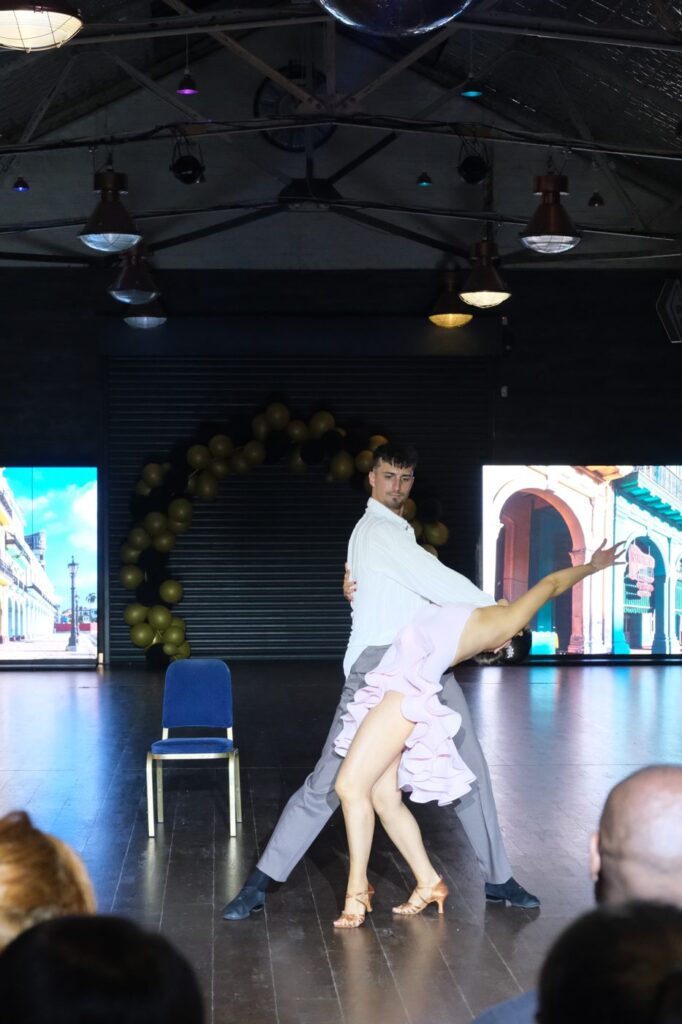
The dress decides the choreography. That’s the part almost nobody tells you when you start looking up how to dance in a wedding dress, and it’s the most useful thing to know before your first lesson. You build the routine around the fabric, the length and the shape you’re actually going to be wearing, rather than picking a routine and hoping the dress cooperates. A first dance in a big dress is a different job from a first dance in a slip dress, and yes, you can dance in a mermaid dress, as long as somebody designs the steps for what a mermaid dress lets your legs do.
We choreograph wedding first dances in London every week, and the same handful of issues come up over and over. Here they are honestly.
The hem and the floor
Everything else is a footnote next to this one. A long dress puts fabric on the floor all around you, and only two things can go wrong with it. Your partner steps on it while moving towards you, or you tread on it yourself while stepping backwards.
The fix is nearly always in how you move rather than in anything you do to the dress. Smaller steps. Less travelling across the floor. More turning on the spot, where the skirt rotates with you instead of being left behind. And, most importantly, the leader learns to step slightly to the side rather than straight forward, so his foot lands beside the fabric rather than on top of it.
That last adjustment sounds small and changes everything. A straight forward step into a partner in a long gown is a step directly into her hem. Angle it out by a few inches and the same movement becomes safe. Simone teaches this in the first lesson with anyone whose dress has real length to it, because there’s no point building a routine and then discovering it can’t be danced.
Backward steps for the bride are the other half. In a heavy skirt you can’t feel where the fabric is behind you, so a long back step means putting your full weight onto your own hem. Short back steps, or none at all.
Trains and bustles
If your dress has a train, you’ll almost certainly be dancing bustled. A bustle is a set of hooks, buttons or ribbon ties that lift the train and fasten it to the back of the skirt, so fabric that trailed behind you during the ceremony sits gathered up for the reception. Someone in your party gets shown how to do it, usually at a fitting.
Here’s the part that gets missed. A bustle changes the shape of the skirt. There’s now weight and volume gathered at the back that wasn’t there before, which alters your balance slightly and changes how the skirt behaves when you turn. A spin that felt clean in the unbustled dress can feel like it’s dragging once the train is up.
So practise once with the bustle up. Not a full rehearsal, just enough to feel it. If you have a fitting where the bustle gets demonstrated, that’s your window. Do a few turns in the shop mirror. You’ll learn more in ninety seconds than from any amount of reading.
What your silhouette allows
The dress is usually chosen long before anyone thinks about the first dance, and that’s fine. None of these shapes is a bad choice. They just ask for different choreography.
A full ballgown is generous. It hides footwork completely, which is a gift if you’re nervous, and it turns beautifully because the skirt has volume and momentum of its own. What it won’t let you do is take a big step. The structure limits how far your legs can separate, so anything with long travelling lines gets rebuilt into rotation and shape.
A fitted or mermaid dress is the opposite. It looks superb standing still and severely restricts how far you can step, sometimes to a few inches. We build those routines around upper body movement, small pivots, weight changes, arm lines and a few well-placed turns. You get an elegant dance, and it’s one of the easier ones to learn because there’s less footwork to remember. What you don’t get is a travelling Waltz around the room.
A softer A-line is the most forgiving thing you can wear. Enough length to look right, enough room to move, not enough weight to fight you.
Whichever you have, tell your instructor the shape at the consultation and bring a photo. It changes which of the dance styles suits your song. A Cha Cha needs leg action a mermaid dress can’t give you. A slow Waltz or a Rumba lives in the upper body and works beautifully.
Shoes
Practise in a heel of similar height to the one you’ll wear. Not the same shoe necessarily, but the same height. Your balance, your posture and the amount of your foot in contact with the floor all shift with heel height, and a routine learned flat feels unfamiliar in three inches.
Brand new soles are slippery. Leather in particular comes out of the box like glass, and a polished venue floor makes it worse. Scuff them before the day, on a rough surface or with a wire brush, until the sole has some texture.
A strap matters more than most brides expect. Court shoes that stay on when you’re walking can shift when you turn, and there’s a moment in every rotation where an unsecured heel wants to leave your foot. An ankle strap, a T-bar or any proper fastening removes that worry.
Plenty of brides change into flats for the reception, and that’s sensible. Do the first dance in whatever you’ll be standing in for it, and rehearse in that. If you know you’ll have kicked the heels off by then, learn the dance flat.
Floors and venues
Ask your venue what you’ll be dancing on, because it changes what’s worth attempting.
Marquee floors are laid in sections, which means seams and a little give underfoot. Fine for turning, less good for anything with a sharp stop. Grass is not a dance floor. If any part of your first dance happens on lawn, keep it slow and small, and expect heels to sink. Historic venues often have beautiful uneven boards, so avoid fast spins and long glides. A small floor with guests standing close in is the most common situation of all, which is another argument for choreography that rotates rather than travels.
We spend a few minutes of the private lessons shrinking the routine to whatever floor you’ve actually got. Martynas is good at that, taking a dance that was built big and making it fit a four-metre square without it looking cut down.
Arms, sleeves, veils and jewellery
Long sleeves and structured bodices limit how high you can lift your arms. Some dresses stop you cleanly at shoulder height, and if the choreography has an overhead turn in it, you’ll find out at the worst possible moment. Tell your instructor about sleeves and bodice structure in the first lesson, and the arm lines get designed around your actual range.
Veils catch on hands during turns. Almost every bride either removes the veil before dancing or keeps the choreography free of anything that passes near her head. Long earrings and statement necklaces do the same on a smaller scale, and rings with raised settings can snag lace.
Rehearse in something long, before the routine is finished
The most useful preparation costs nothing. Find something of a similar length and weight, an old long skirt or a dressing gown, and run your steps in it at home.
Do this before the choreography is finalised, not after. If your routine turns out to need a step your dress won’t allow, that’s easy to change while the dance is still being built and irritating to change the week before the wedding. Bring the skirt to a lesson if you’d rather test it with someone watching.
Book an intro lesson and consultation, bring a photo of the dress and a rough idea of your song, and we’ll tell you honestly what will work. You can see the full range of what we offer, or read more about wedding first dance lessons before you get in touch.
Common questions
Should I dance with my bustle up or down?
Up. A train left down will be stepped on within the first eight bars. Have whoever is doing your bustle fasten it before the dancing starts, and try turning in it once beforehand so the changed shape of the skirt isn’t a surprise.
What shoes should I practise in?
Whatever height you’ll actually dance in. Scuff the soles before the day so they grip, and choose something with a strap or fastening so the shoe stays put through turns. If you plan to be in flats by the time the first dance happens, learn the routine in flats.
Can you dance in a mermaid dress?
Yes, with choreography built for it. The routine lives in the upper body, small turns and weight changes rather than stepping, and it looks elegant precisely because it’s controlled.
How far in advance should we book?
Two to three months of regular lessons suits most couples, and more if you want something detailed or neither of you has danced before. Earlier is better if your date falls in summer.
Dance Amore Studio is at 1 Chilworth Mews, London W2 3RG, three minutes’ walk from Paddington station, open Monday to Saturday, 10am to 10pm. Call 07737 893113, WhatsApp 07480 387419 (text only) or email danceamorestudio@gmail.com. Full details are on the contact page.