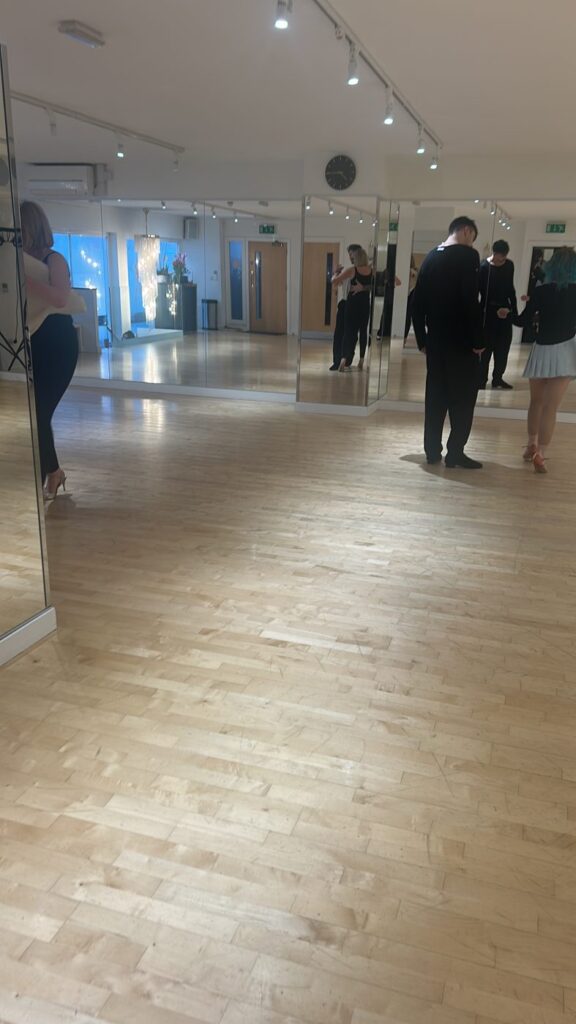
Here’s what to expect at your first dance lesson at Dance Amore: one studio, one professional instructor, and you. There’s no partner to bring, no group to keep up with and no audience. You’ll talk for a few minutes, learn a small amount of material, dance it to music before you leave, and go home without having committed to a course.
Most people who get in touch say some version of the same thing first. They can’t dance, they have no rhythm, they’ve left it too late, and they don’t want to embarrass themselves in front of a room. In a private one to one lesson there’s no room to embarrass yourself in front of. So here’s the whole thing, in the order it happens, so that what you turn up to is what you already pictured.
What to expect at your first dance lesson, before you arrive
Two small things are worth sorting out beforehand, and neither of them is difficult.
Clothes first. Wear something you can move in and feel like yourself in. There’s no dress code, nothing to buy, and nobody is expecting sequins.
Shoes matter more. Don’t buy dance shoes yet. Bring something with a smooth sole that stays on your foot: a leather-soled shoe, a court shoe with a modest heel, or clean indoor shoes you can turn in. Trainers with heavy grip are the one thing that genuinely makes a first lesson harder, because the sole grabs the floor exactly when you want to pivot. If you own nothing suitable, come in socks and say so when you arrive.
Then there’s finding us. The studio is at 1 Chilworth Mews, London W2 3RG, a three minute walk from Paddington station. Chilworth Mews is a quiet side turning, so look it up on your phone before you set off rather than at the corner in the rain. There’s no parking nearby, which is why almost everyone comes by tube. Give yourself five extra minutes the first time. Arriving flustered is a poor start to something you’re already nervous about.
The first few minutes
You arrive, you’re met at the door, you put your coat and bag down. Nobody is dancing at you while you do it.
The lesson opens with a conversation, and it’s a real one rather than a sales script. Your instructor will want to know three things: whether you’ve danced before (the honest answer is fine, and for most people it’s weddings and school discos), what made you get in touch now, and what you’d like to be able to do. Those answers change everything that follows. Someone with a wedding in three months needs a different first lesson from someone who wants one hour a week that belongs entirely to them.
This is also the point to say what you’re worried about. If you’re anxious about being watched, about your knees, about being older than you assume everyone else is, say it out loud in the first two minutes. It’s useful information, and it’s heard several times a week.
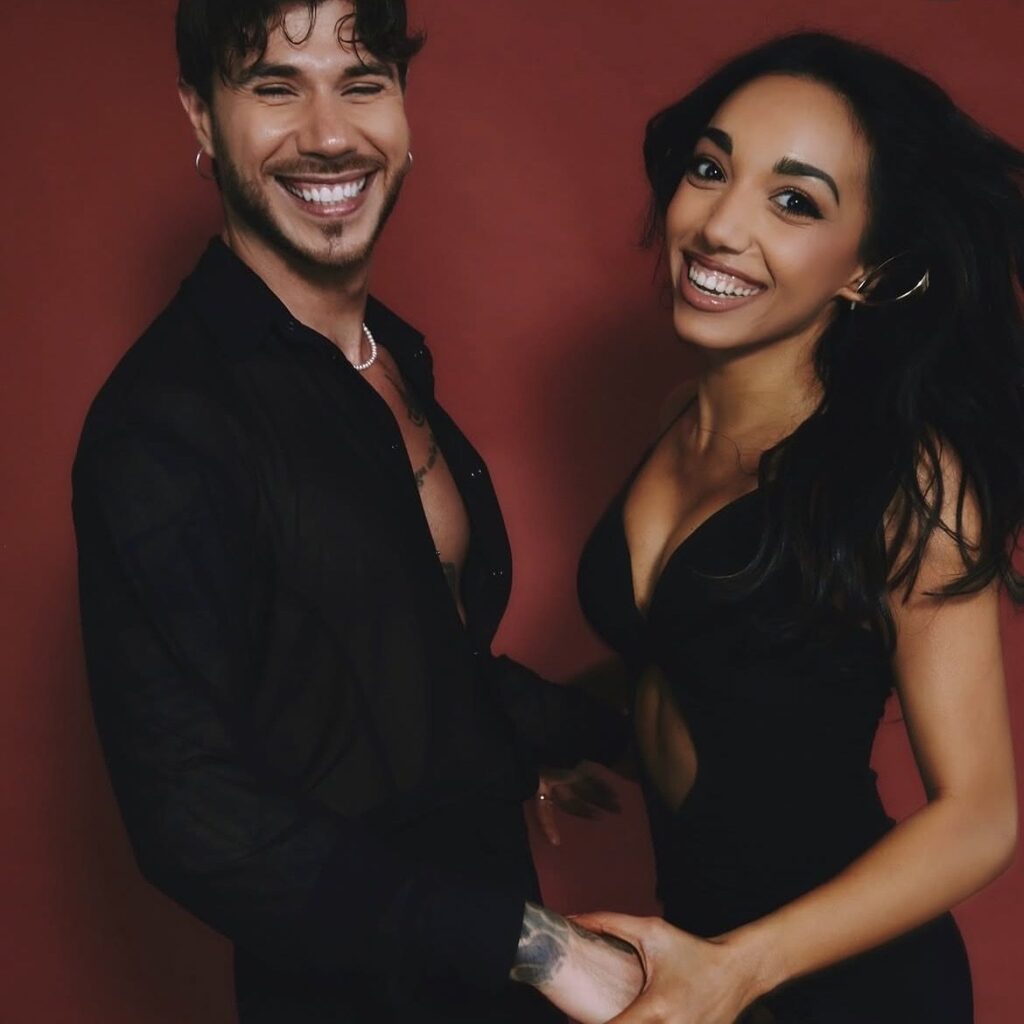
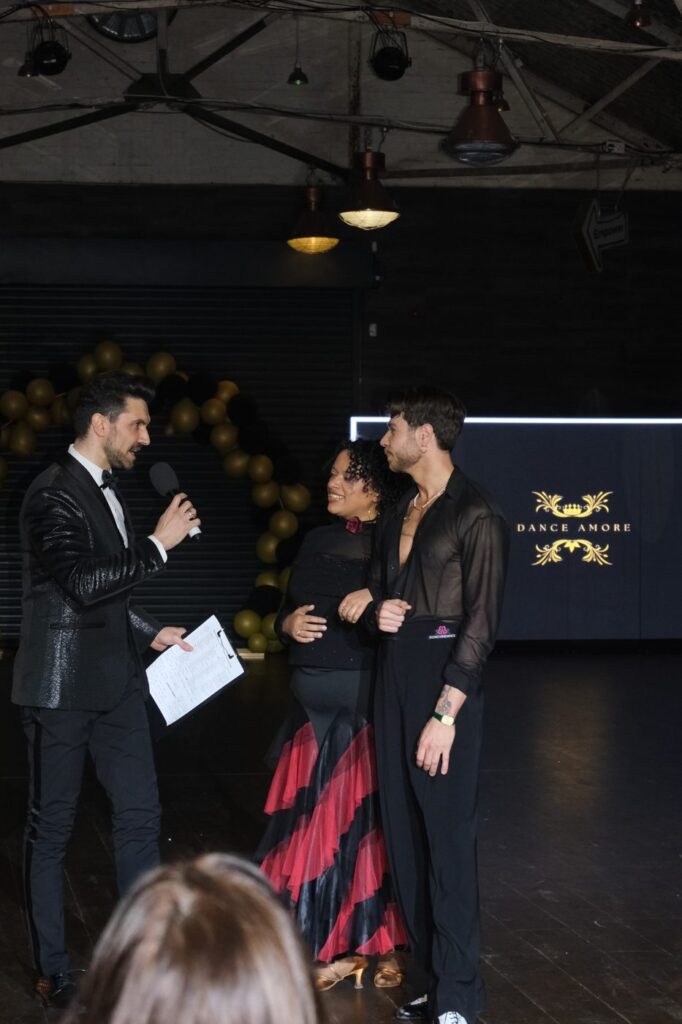
You’ll be dancing with either Simone Arena, who founded the studio, or with Martynas, who teaches many of the private lessons here. Simone is a former Italian Ballroom and Latin Champion, won series three of Dancing with the Stars in Belgium, reached the final of Dancing with the Stars Ireland in 2024, and spent over ten years touring with the Broadway production Burn the Floor. You can read more about Simone and the studio before you come. Martynas teaches the same way: quietly, in small pieces, with a lot of patience for the first half hour.
Then you’ll be shown how to stand and how to hold. Nothing dramatic. Weight slightly forward, shoulders down, arms held rather than clamped. You’ll be in a proper hold within a few minutes, and for most people that’s the moment the nerves drop, because it turns out to be far less awkward in the room than it was in your head.
Learning your first steps
You won’t be taught a routine, and you won’t be given more than you can hold. A small amount of material, and then real time to get it.
Which dance will you learn?
Usually one dance and two or three figures. Which one depends on the conversation you’ve just had. A Waltz if you want something classic and slow enough to think inside. A Cha Cha or a Salsa if you’d rather do something bright and quick and immediately fun. A Tango if you want the one that makes you walk differently for the rest of the week. We teach Ballroom, Latin, Tango, Waltz, Cha Cha, Salsa and more, so you can look through the dances we teach beforehand and arrive with a preference if you have one. If you don’t, that’s fine. Your instructor will pick.
What if you’re bad at it?
The teaching goes in layers. Footwork on its own first, walked slowly, no music, no hold, until your feet know where they’re going. Then the same steps in hold. Then with a count out loud. Then, once it’s holding together, with music underneath it.
You will get things wrong in this part. That isn’t the lesson going badly, that is the lesson. Nobody stands there disappointed in you. What actually happens is that one thing gets adjusted, usually your weight, the size of your step or where you’re looking, and you try it again, and the correction is smaller than you expected. Because these are private one to one lessons, the pace is set by you and nobody else. There’s no group moving on without you.
Dancing to music
Somewhere around the middle of the lesson the music goes on properly and you dance.
It’s short, a minute or so at a time, and it’s the part people remember. Counting out loud gives way to hearing the beat. The steps you were concentrating very hard on ten minutes earlier start arriving slightly before you think about them. It isn’t polished and it isn’t meant to be, but it’s unmistakably dancing rather than practising.
This is also where the pro-am model earns its keep. Dancing with a professional means you’re held properly and led properly from the first minute, so you get to feel what the dance is supposed to feel like rather than two beginners guessing at it together.
The last few minutes
The lesson winds down with a short recap. You’ll be told plainly what worked and what to work on, and usually given one small thing to practise at home, normally something you can do in a kitchen in two minutes with no partner and no space.
Then there’s the consultation part, a conversation about what a plan for you would look like. Weekly private lessons. A short block before a wedding. Group classes alongside your one to one work. A pro-am programme if you like the idea of a show or a competition one day. Nothing is decided on the spot.
Things worth asking while you’re there:
- How often you’d need to come to reach what you described
- How long lessons run and how they’re booked
- What a plan for your particular goal would include, and what it would cost
Cost is discussed privately, in person, once your instructor knows what you’re actually after. That’s deliberate. A wedding couple with eight weeks and a chosen song and someone who wants a standing Tuesday evening need different things, and quoting either of them before that conversation would be guesswork.
What happens next
If you carry on, most people settle into regular private lessons, sometimes with a group class alongside. Couples with a date in the diary tend to book a short run of wedding first dance lessons built around their song. Corporate groups book workshops. A few people discover they want to compete, and start down that road.
If you decide it isn’t for you, that’s a perfectly good outcome, and far better than spending another year wondering.
Common questions
Do I need a partner?
No. Every private lesson here is one to one with a professional instructor, so you dance with them. Coming alone is the normal way to start, not the exception.
I have no sense of rhythm. Is that a problem?
It’s the most common thing people say about themselves and it’s usually not true. Timing is taught, counted and practised like everything else. If you can walk and count to three, there’s a Waltz in you.
Will other people be watching me?
No. Your lesson is yours. Another lesson may be running elsewhere in the studio, but everyone in the building is concentrating on their own feet.
Am I too old to start?
No. People start in their forties, fifties and later all the time, and one to one teaching means the lesson is built around your body and your pace rather than a class average.
Book an intro lesson
The studio is open Monday to Saturday, 10am to 10pm, at 1 Chilworth Mews, London W2 3RG, three minutes from Paddington station. The first step is an intro lesson and consultation, where you dance a little, talk through what you want, and find out whether this suits you.
Text or WhatsApp 07480 387419, or call 07737 893113. There’s often music playing in the studio, so a message usually reaches us faster than a call. You can also email danceamorestudio@gmail.com or use the contact page. Tell us roughly what you’re after and whether you’ve danced before, and we’ll take it from there.