No, it isn’t, and age is rarely the thing that actually stands in the way. If you have typed “am I too old to start ballroom dancing” into a search bar recently, you will have noticed that most of what comes back is written by American retirement communities, which tells you very little about what it would be like to walk into a London studio at 44 or 58 or 71 and learn a waltz. Adult beginner ballroom is completely ordinary. Starting ballroom in your 50s is completely ordinary. Plenty of people who dance with us in Paddington began well into adult life, and a fair number spent a year or two thinking about it before they picked up the phone.
The question you are typing is about age. The question underneath it is usually something else: whether you will feel foolish, whether your body will cooperate, and whether everyone else in the room will be twenty years younger and already good at it.
What actually changes, and what doesn’t
Three things tend to shift as the years go on, and none of them are dealbreakers.
Balance takes a little longer to build. Not because it has gone, but because most adult life involves very little of it. If you spend your days sitting and walking on flat pavements, you have not asked much of your ankles and hips lately. Dancing asks. Within a few weeks of regular lessons that starts to come back, and it is one of the changes people notice first, usually outside the studio rather than in it.
Confidence takes longer to build too. A child throws themselves at a new skill without much thought about how it looks. Adults are more self conscious, and there is no point pretending otherwise. What helps is repetition, in a room where nobody is watching you.
The third change is that you are more aware of your own body, which cuts both ways. You notice a stiff hip or a knee that complains on stairs. You also notice how you are standing and how your weight moves, and that awareness is genuinely useful in dancing.
Now the part that surprises people. Memory for sequences is fine. Adults learn choreography perfectly well, and in some ways more reliably than children, because you can hold a whole figure in your head as an idea rather than a set of copied shapes. Adults also learn faster than children overall, for the simple reason that you can be told what to do and understand it. A child needs to see something fifty times. You can be told that your weight belongs over the front foot, and you can put it there. That single advantage does more for your progress than youth ever did.
Thirty, fifty and seventy are different, but not in the way you’d think
At thirty you pick up physical habits quickly and you are probably impatient. The usual difficulty is time, not ability: lessons get moved for work and the gaps between them grow.
At fifty you tend to be a better student. You listen, you ask sensible questions, you practise what you were asked to practise. Progress is steady and often quicker than the thirty year old’s, because it is consistent. Most of the people asking whether they have left it too late are in this bracket, and it is a straightforwardly good time to start.
At seventy the pace of a lesson is calmer and the goals are usually different, though not smaller. You may work on fewer figures and spend more time on quality and on the feeling of moving well to music. What matters is that lessons are built for the body you have rather than a general template.
Whatever your age, mention anything relevant to your instructor at the start, so lessons can be adapted around it, and check with your GP if you are unsure whether something is suitable for you.
The worries people don’t say out loud
Knees and hips. Ballroom and Latin can be danced at a range of intensities. Rise and fall in the waltz can be softened. Latin hip action can be reduced or built up gradually. A private lesson is the right setting for this, because the whole hour bends around you rather than around the average of a group.
Being out of practice with exercise. A private lesson is not a fitness class and nobody expects you to arrive fit. You will be moving for most of an hour, at a pace your instructor sets. People who have not exercised in years generally cope well, partly because you are concentrating too hard to notice.
Not being able to remember a routine. For your first months there is no routine to remember. You learn a handful of figures and how to move between them, and your instructor leads you through anything you have not yet retained. Nobody is testing you.
Feeling watched. Our studio in Chilworth Mews is a private space, and in a one to one lesson the only person watching is the person teaching you. That is a very different experience from standing at the back of a group class hoping the row in front hides you.
Starting on your own. You do not need a partner. We work on a pro-am basis, which means you dance with a professional instructor, so there is no waiting to be paired up and no arriving with a reluctant spouse. Many of our students come alone and stay that way quite happily.
Why one to one suits an adult beginner
Group classes move at the speed of the group. If you need a figure explained twice you fall behind, and if you pick it up quickly you spend the rest of the hour waiting. Neither is much fun when you are already slightly nervous about being there.
In a private lesson the hour belongs to you. If your balance needs ten minutes of attention, it gets ten minutes. If cha cha is not landing today, you dance a different style instead and come back to it. Your instructor, whether that’s Martynas or one of the team, sees exactly what you are doing and corrects it before it sets into a habit, which saves months.
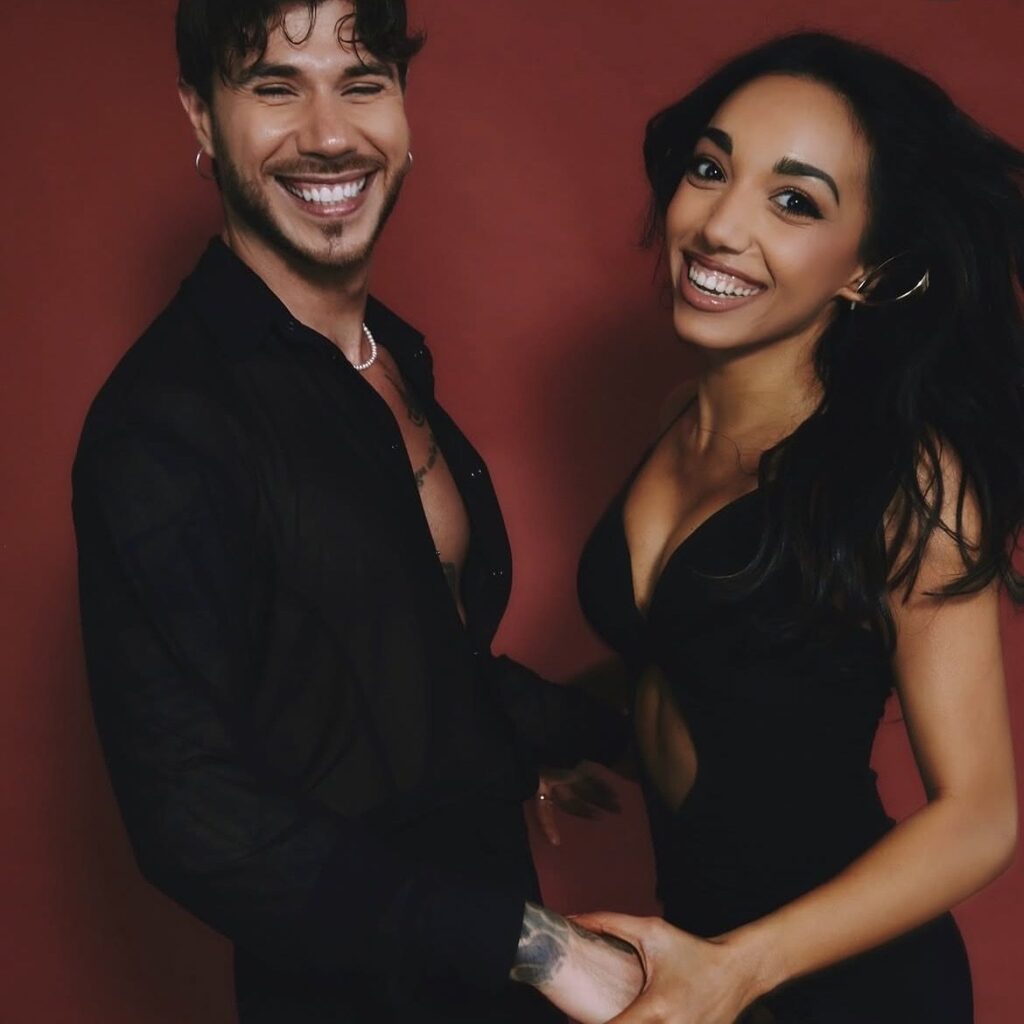
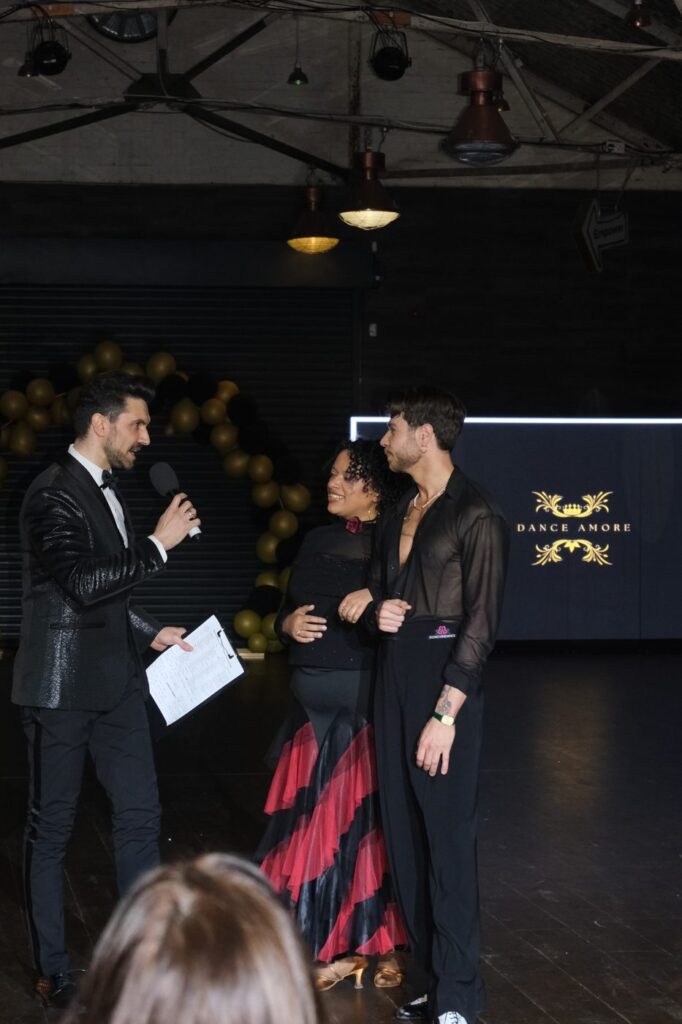
Simone Arena, who founded the studio, is a former Italian Ballroom and Latin Champion, won the third series of Dancing with the Stars Belgium, reached the final of Dancing with the Stars Ireland in 2024, and spent over ten years with the Broadway production Burn the Floor. You can read more about the studio and the people teaching there.
What a realistic first year looks like
In the first month or two you learn how to stand, how to move your weight, and the basic figures of one or two dances. It feels awkward and then suddenly less so.
By around six months of regular lessons, most people can dance a waltz, something Latin and perhaps a tango competently. You will look like someone who dances rather than someone counting.
By a year, if you have kept turning up, you are working on quality rather than survival. Some students at that point start thinking about a first showcase, a competition, or a wedding first dance for their own or a family member’s day.
That timeline depends far more on how often you come than on how old you are. One lesson a week, consistently, will beat three lessons in a burst followed by two months off, every time. This is the honest bit: the people who progress are the people who show up.
Ballroom and Latin are among the few physical activities people carry on with for decades. There is always another dance and another level of detail, and none of it requires you to be young.
Frequently asked questions
Am I too old to start ballroom dancing at 65?
No. People start in their sixties, seventies and beyond. What changes is the pace of the lesson and how it is structured, not whether you can learn. Tell your instructor about anything physical you want taken into account, and the lesson is built around it.
Do I need to be fit to start?
No. You need to be able to walk comfortably for an hour with breaks. Fitness improves as a side effect of dancing regularly, but it is not a requirement for walking in the door.
Can I start ballroom dancing without a partner?
Yes. Our pro-am model means you dance one to one with a professional instructor, so you never need to bring anyone or be paired with a stranger. Most people who contact us are on their own.
How often should I take lessons as a beginner?
Once a week is the usual starting point and it is enough to make real progress. Some people add a second lesson when a wedding dance or a showcase is coming up, but consistency matters more than volume.
If you have been thinking about this for a while, the next step is an introductory lesson and a chat about what you want from it, with no pressure to commit to anything afterwards. We are at 1 Chilworth Mews, W2 3RG, three minutes’ walk from Paddington station, open Monday to Saturday, 10am to 10pm. Text or WhatsApp 07480 387419, call 07737 893113, or email danceamorestudio@gmail.com. There is often music playing in the studio, so a message usually reaches us faster than a call. You can also get in touch here.